
Tarot’s Secret Skeleton: Do You Really Need the Qabalah?
Updated: Jan 14

Ever noticed how some Tarot books start sounding like a PhD in ancient mysticism? If you’ve ever felt like you needed to learn Hebrew, Astrology, and Alchemy just to pull a daily card, you’ve probably bumped into the Qabalah.
It’s often called the "skeleton" of Tarot, providing the internal structure for some of the world’s most famous decks. But is it an ancient secret, or just a really clever marketing stunt from the 1800s? Let’s pull back the veil.
1. The Many Faces of the “Q” First things first: why so many spellings? In the Tarot world, the letter you use tells everyone which “flavor” you’re studying:
Kabbalah (with a K): The original Jewish mystical tradition, rooted in the Torah.
Cabala (with a C): The Christian interpretation that emerged during the Renaissance.
Qabalah (with a Q): The Hermetic or Occult version—the one usually found in Tarot—which mashes together Egyptian myths and Alchemy.
2. The 19th-Century Branding War
In the mid-1800s, French occultist Eliphas Lévi noticed something: there are 22 Major Arcana cards and 22 letters in the Hebrew alphabet. He claimed this wasn't a coincidence, but a secret preserved from the ancient Egyptian Book of Thoth.

The truth? Egypt was the “Silicon Valley” of ancient wisdom back then—if you wanted your system to seem powerful, you claimed it came from the Nile. In reality, these connections were a fanciful "upgrade" to make the cards feel more legitimate.
3. Is the Qabalah a "Cheat Code" or a Trap?
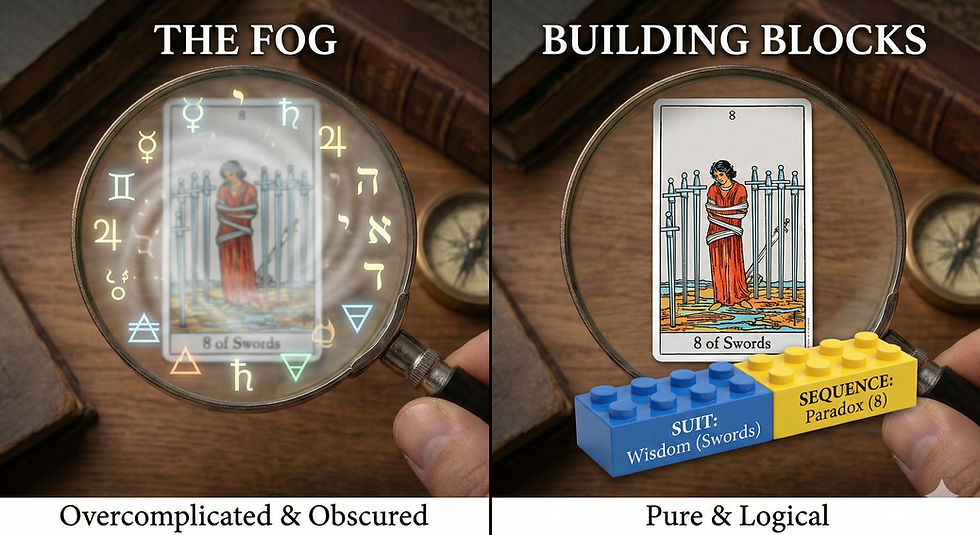
Most modern Tarot literature treats the Qabalah as a given. Why? Because it provides a System of Logic. If you know the "DNA" of a specific sphere on the Qabalistic Tree of Life, you theoretically understand all four cards of that number in the deck.
However, there’s a catch. This can lead to "Esoteric Gatekeeping". Instead of using simple, logical building blocks, students are told they must learn massive amounts of unrelated lore just to understand a single card.
4. Why We Choose Logic Over Lore
At its heart, the Qabalah is a "pasted on" framework. The suits (Swords, Cups, Coins, and Wands) existed for centuries as symbols of social classes—like the Clergy and the Nobility—long before anyone mentioned the Tree of Life.

While the Golden Dawn (the creators behind the Rider-Waite-Smith deck) were obsessed with a "Grand Unified Theory" where everything had to fit perfectly, the result was often a "forced fit". They even swapped cards like Strength and Justice just to make their astrological math work!
The Bottom Line
The Qabalah is a fascinating tool, but it isn't an "ancient law". You can use its structure to organize the chaos of the 78 cards, but you don’t need to be a scholar of Hebrew or Astrology to be a great Tarot reader.
Sometimes, the most powerful insights don't come from ancient ciphers, but from the simple, universal logic of the geometric shapes and symbols right in front of you.
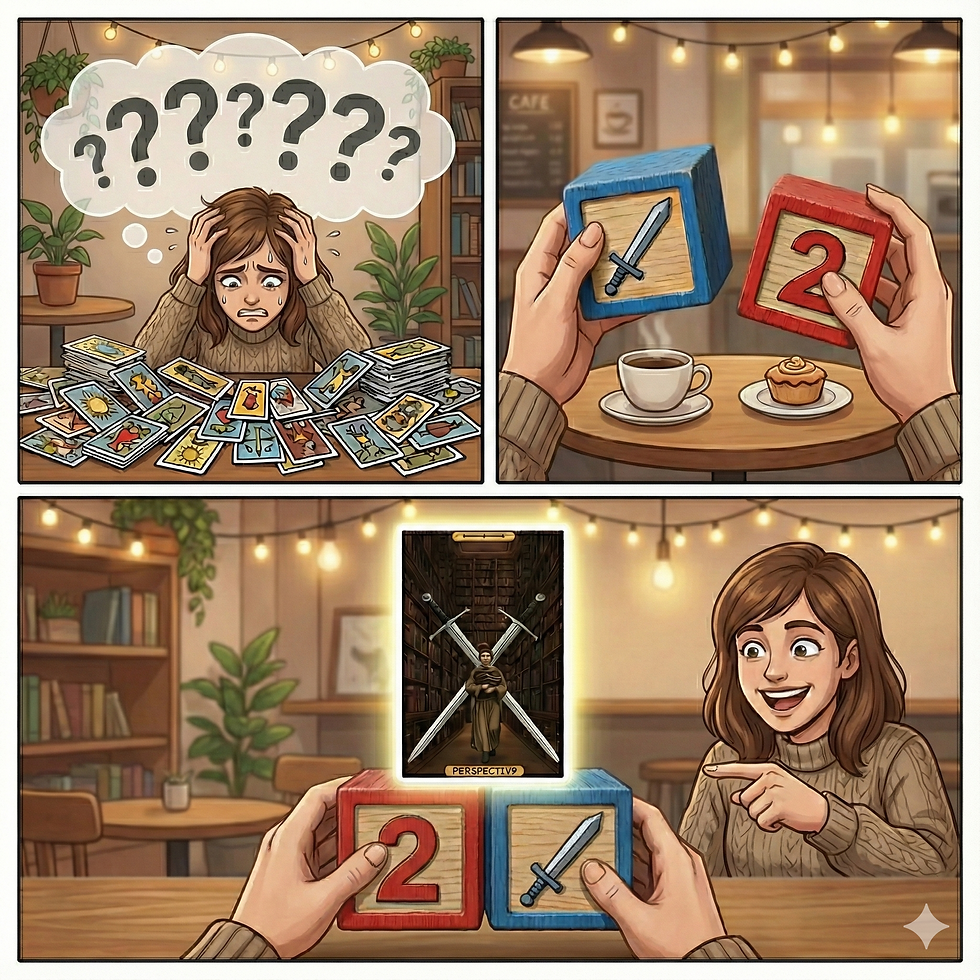
Curious about the "Building Blocks" approach? Check out the rest of Module 5 to see how geometry replaces gatekeeping!
The Tarot Building Blocks Course available now


Comments