
Why the "Building Blocks" Approach is the Future of Tarot
Stripping Back the Fog:
The modern Tarot world is crowded. If you pick up a textbook today, you aren't just learning cards; you’re being asked to learn Hebrew letters, astrological houses, the Four Elements, and the Tetragrammaton.
We are told these "systems" help us understand the cards. In reality? They create a fog. They are layers of "add-ons" bolted onto the Tarot centuries after its creation, often obscuring the very symbols they claim to explain.
The Building Blocks Course is about one thing: Purity. We are stripping away the "tacked-on" occultism to get back to the core DNA of the deck.
The "Add-On" Problem: When Tarot Becomes Everything But Tarot
For the first 350 years of its life, Tarot didn't need "Air, Earth, Fire, and Water". The "fog" began in the late 18th century with a wave of Egyptology and "Fake History." Occultists like Etteilla (Jean-Baptiste Alliette) became obsessed with the idea that Tarot was actually a lost "Book of Thoth" from ancient Egypt. To make the cards fit this narrative, they began "bolting on" external systems
The Elements: Forcing Wands into "Fire" or Swords into "Air."
The Tetragrammaton: Overlaying the four-letter name of God.
Astrology: Linking cards to planets and zodiac signs.
The Problem: These aren't Tarot. They are separate disciplines. When you rely on them, you aren't reading the card; you’re reading a chart. This "fogs" the meaning, making the deck feel like a complex problem rather than a cohesive story.
The Pitfalls of Traditional Learning
Before we get to the solution, we have to look at why the "standard" ways of learning often fail:
Rote Memorization: This is a "massive memory test." It’s brittle. If you forget the specific keyword for the 7 of Wands, your reading stops dead. You become a "keyword parrot" rather than a reader.
Pure Intuition: Intuition is a wonderful tool, but it is unreliable. If you are tired, stressed, or reading for someone you care about, your intuition can "go quiet." Without a logical bedrock, you have nothing to fall back on.
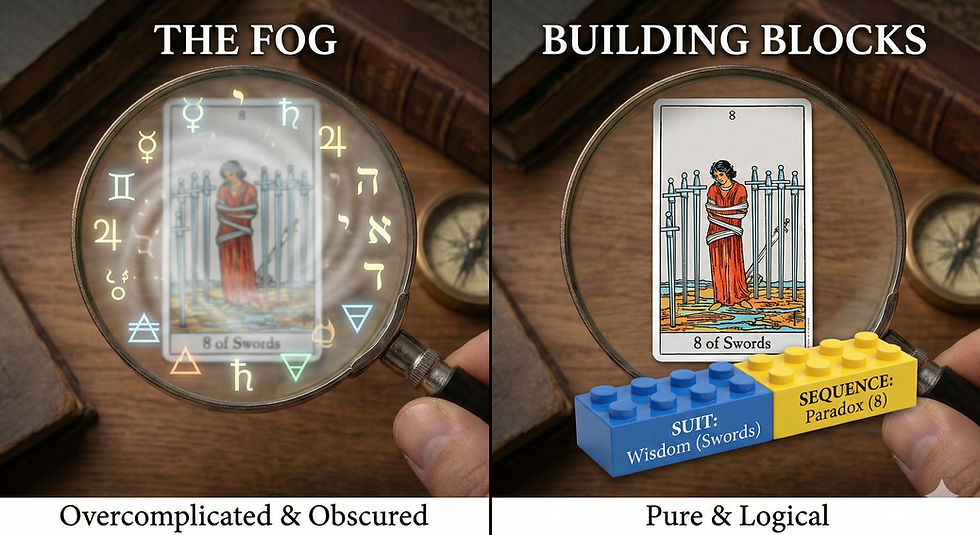
The Building Blocks Solution: Purity and Logic
Our approach is built on a simple, immutable formula:
[Meaning of the Suit] + [Meaning of the Sequence Number] = The Card Meaning.
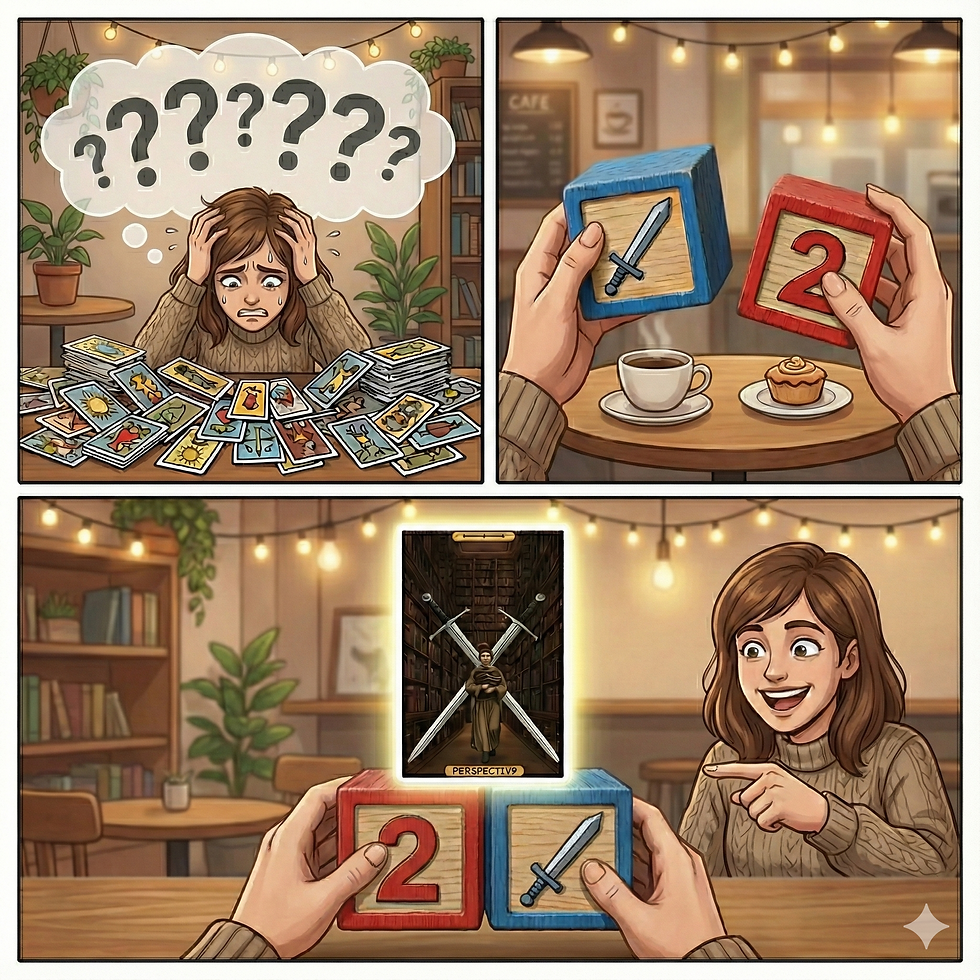
It is "Tarot Math." Instead of memorizing 78 definitions, you learn two sets of core concepts (the "Blocks").
Block 1: The Suits (The "What")
We look at what actually ties a suit together. For example, we don't just say Wands are "hot"; we look at them as the realm of Potentiality. We find the core concept that flows through all 14 cards of that suit.
Block 2: The Sequence (The "Where")
We look at the journey from 1 to 10. We don't use generic numerology; we use the internal logic of the Tarot’s own progression.
The Synthesis (The Result)
When you add these blocks together, the card reveals itself. You don't have to "remember" a specific card. You simply know the card through its root meaning.
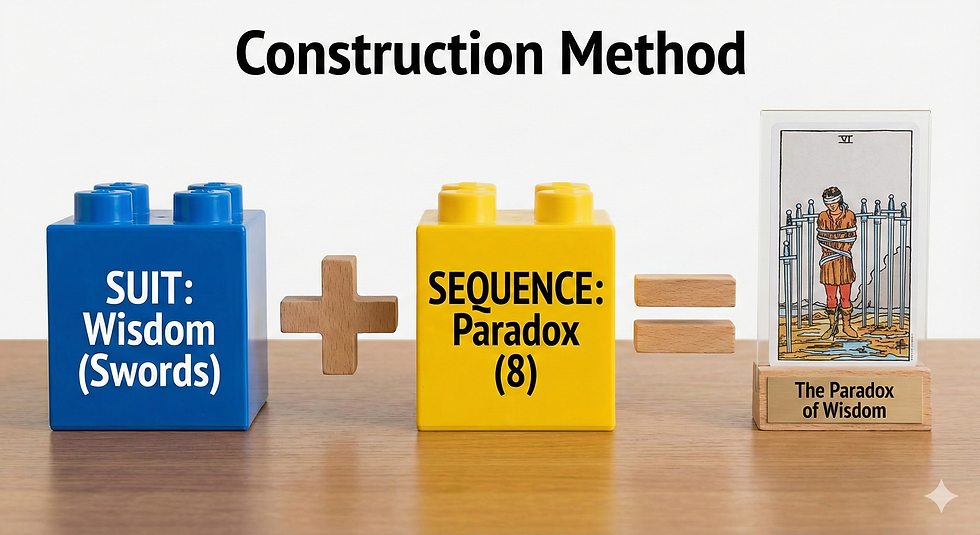
The "After": The Building Blocks Logic
When we strip away the "add-ons," we use the Tarot Math formula. We don't need to look at the picture to know what the card means; we look at the structure.
Step 1: The Suit Block (Swords = Wisdom)
In this approach, Swords are not just "thoughts" or "conflict." They represent Wisdom—the ability to apply judgment, experience, and discernment to the world.
Step 2: The Sequence Block (8 = Symbolic Dualism / Paradox)
The number 8 represents the synthesis of two truths. It is a Paradox. It’s the moment where two opposing things are both true at the same time, creating a complex, interlocking reality.
Step 3: The Synthesis (Wisdom + Paradox)
When you combine Wisdom with Paradox, the meaning of the 8 of Swords becomes clear: The Paradox of Wisdom.
The Breakthrough Interpretation
Instead of telling someone they are a "victim," the Building Blocks approach reveals the deeper truth:
The 8 of Swords is about the realization that some problems cannot be solved with simple logic. The "paradox" is that the more you try to think your way out of the situation (using your "Swords"), the more "bound" you feel. The Wisdom of the 8 is learning to sit in the tension of the paradox. It’s the moment you realize that "Knowing" and "Not Knowing" are both necessary.
The blindfold isn't a trap; it’s a symbol of turning away from external "facts" to understand an internal, paradoxical truth.
Why This is Better
It’s Empowering: You move from seeing a "victim" to seeing someone undergoing a high-level intellectual transition.
It’s Reliable: You don't have to remember "Gemini" or "Air." You just have to know what a Sword is and what an 8 is.
It’s Deep: It gives the querent a real path forward. It explains that their "stuckness" is actually a necessary part of gaining a more complex type of wisdom.
Art as the Mirror, Not the Mystery
The most common mistake beginners make is staring at the artwork and waiting for it to "speak" to them. They try to decode the symbols, the colors, and the facial expressions like a detective at a crime scene. But if you don't have the foundation, you are just guessing.
In the Building Blocks approach, we flip the script: The logic comes first; the art comes second.
Once you understand the internal "Tarot Math"—the synthesis of the Suit and the Sequence—the artwork ceases to be a confusing puzzle. Instead, it becomes a visual confirmation of what you already know to be true.
Seeing the 8 of Swords Clearly
Let’s go back to our example: Wisdom (Swords) + Paradox (8). Now that you know the 8 of Swords is about the Paradox of Wisdom, look at the traditional RWS imagery again. It suddenly transforms:
The Swords: They aren't a cage built by an enemy; they are a boundary of the mind. They represent the intellectual "Swords" of the past that have led the person to this moment of standstill.
The Blindfold: This isn't a sign of being kidnapped. It is the visual representation of the Paradox. To find the highest level of Wisdom, the figure must stop looking at external "facts" and turn their vision inward to resolve the tension within.
The Bindings: Notice how loosely they are tied. This is crucial. It confirms that this isn't a situation of external victimhood. The restriction is internal—a paralysis caused by overthinking the "Paradox." They are trapped not by actual ropes, but by their own intellect hesitating to act amidst complex truths.
You aren't guessing what the blindfold means anymore. You are seeing the "Paradox" represented in the art.
The Freedom of Being "Deck-Independent"
This is where the true power of the Building Blocks approach lies. When you rely on memorizing the art of a specific deck (like the Rider-Waite-Smith), you are tethered to that deck forever. If someone hands you a minimalist deck or a classic Tarot de Marseille, you’re lost.
But when you understand the Building Blocks, you become deck-independent. The art becomes a beautiful, helpful mirror of the truth you already hold in your hands. You aren't searching for the meaning in the paint; you are bringing the meaning to the paint.

Why This Leads to Deeper Mastery
Let’s be honest: This isn't a "quick fix." It takes more effort to understand the logic of a suit than it does to memorize a single keyword like "Victory."
However, the payoff is permanent.
It’s Unshakable: Even if you've never seen a specific deck before, you can read it instantly because the geometry and the suits don't change.
It Frees Your Mind: When the "base layer" (the card's meaning) is logical and automatic, your brain is free to do the "top layer" work—interpreting nuances, connecting cards, and then letting intuition play its proper role.
Stop Memorizing. Start Building.
If you are tired of the fog—the elements, the astrology, the endless flashcards—it’s time to get back to basics. Learn the language, not the lines.
Comments