
Beyond the Veil
Or, Why I Don't Like Keywords
Arthur Edward Waite, perhaps the most influential name in modern Tarot, viewed cartomancy and fortune-telling with near-total contempt. In his seminal work, The Pictorial Key to the Tarot (1911), he spared little effort in dismissing them as superficial nonsense.

The Debris of Fortune-Telling
Waite characterized the popular interest in Tarot as something belonging to the trash heap of spiritual history. He argued that the cards had been degraded by common use:
"...we meet with the Tarot cards at the outermost gates—amidst the fritterings and debris of the so-called occult arts, about which no one in their senses has suffered the smallest deception; and yet these cards belong in themselves to another region." — Part I: The Veil and Its Symbols, Section 1: "Introductory" (p. 3)
In plain English, Waite is asserting that while most people first encounter Tarot through cheap parlor tricks and superstitions, the cards themselves actually belong to a much higher, more spiritual level of reality. No sensible person should be fooled by the debris of common fortune-telling.
He further separated the serious student from those who used the cards for profit:
"The subject has been in the hands of cartomancists as part of the stock-in-trade of their industry; ...it has been there in the hands of exponents who have brought it into utter contempt for those people who possess philosophical insight." — Part I: The Veil and Its Symbols, Section 1: "Introductory" (p. 4)
Essentially, Waite believed professional fortune-tellers had so thoroughly commodified the Tarot that deep thinkers had come to look down on the entire subject with total disrespect. These quotes form the backbone of his argument for a Rectified deck: his mission was to rescue the Tarot from the industry and return it to the world of philosophy.

The Problem with Etteilla
Waite placed considerable blame on Etteilla (the pseudonym of Jean-Baptiste Alliette), the first professional Tarot occultist to make a living through card divination. Etteilla popularized the historical inaccuracy that the Tarot was a literal Book of Thoth from Ancient Egypt—a claim Waite found vulgar and embarrassing.
Waite made his disdain personal:
"It was the illiterate but zealous adventurer, Alliette, that perruquier [wig-maker] who took himself with high seriousness and posed rather as a priest of the occult sciences." — Part I: The Veil and Its Symbols, Section 4: "The Tarot in History" (p. 40)
Waite dismissed Etteilla as an uneducated former wig-maker who played the part of a high priest, without understanding the true depths of the science. He even referred to Etteilla’s work as wearisome and barbarous, suggesting his methods lacked the spiritual grace of true mystical study.
Why Waite Included Keywords
Despite his disdain, Waite still provided lists of keywords in his guide—many of which still influence Little White Books (LWB) today. If you see the Three of Swords and immediately think heartbreak, you are following a tradition that Etteilla started, and Waite popularized.
So why did a man who despised fortune-telling include these meanings?
Commercial Necessity: Waite was a professional writer. His publisher, William Rider & Son, knew that a deck without predictive keywords would not sell to the general public.
The Dual Audience: Waite served two masters. He provided common meanings for the masses, but peppered the text with hints that these were superficial.
The Doctrine of the Veil: He frequently referred to keywords as a veil or shell, intended only for those who hadn't been initiated into the secret tradition.
For a scholar who used pseudonyms like Grand Orient to protect his academic reputation from his bread-and-butter commercial writing, the Pictorial Key was a delicate balance. He often admitted that the fortune-telling meanings were mere shadows of the truth:
"The Magician... this is the colportage interpretation, and it has the same correspondence with the real symbolical meaning that the use of the Tarot in fortune-telling has with its mystic construction." — Part II: The Doctrine of the Veil, Section 2 (p. 73)
To Waite, the "colportage" (cheap, mass-produced) interpretation was, to the real meaning, what a child’s drawing is to a masterpiece.

The Map vs. The Territory
Waite eventually offered a disclaimer at the start of his divinatory section:
"Regarding the divinatory part... I consider it personally as a fact in the history of the Tarot [rather than a spiritual truth]... I have drawn, from all published sources, a harmony of the meanings... they are designed to set aside the follies and impostures of past attributions." — Part III: The Outer Method of the Oracles, Section 1 (p. 174)
Waite viewed these keywords not as wrong, but as incomplete. He believed:
The cards are symbols of universal laws, not just signs of personal events.
A keyword is a static point, whereas a symbol is an "infinite well".
The keyword is the "Map," not the "Territory." Just as a map showing a mountain’s height cannot capture the wind, the cold air, or the physical presence of the mountain itself, a keyword like "Success" or "Marriage" is a pale reflection of the massive concepts behind the cards.
The Building Blocks Approach
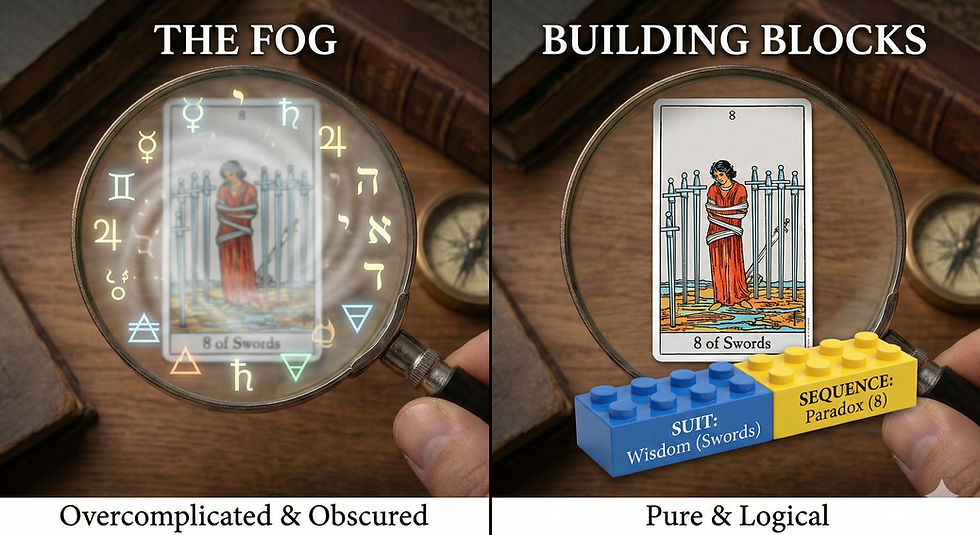
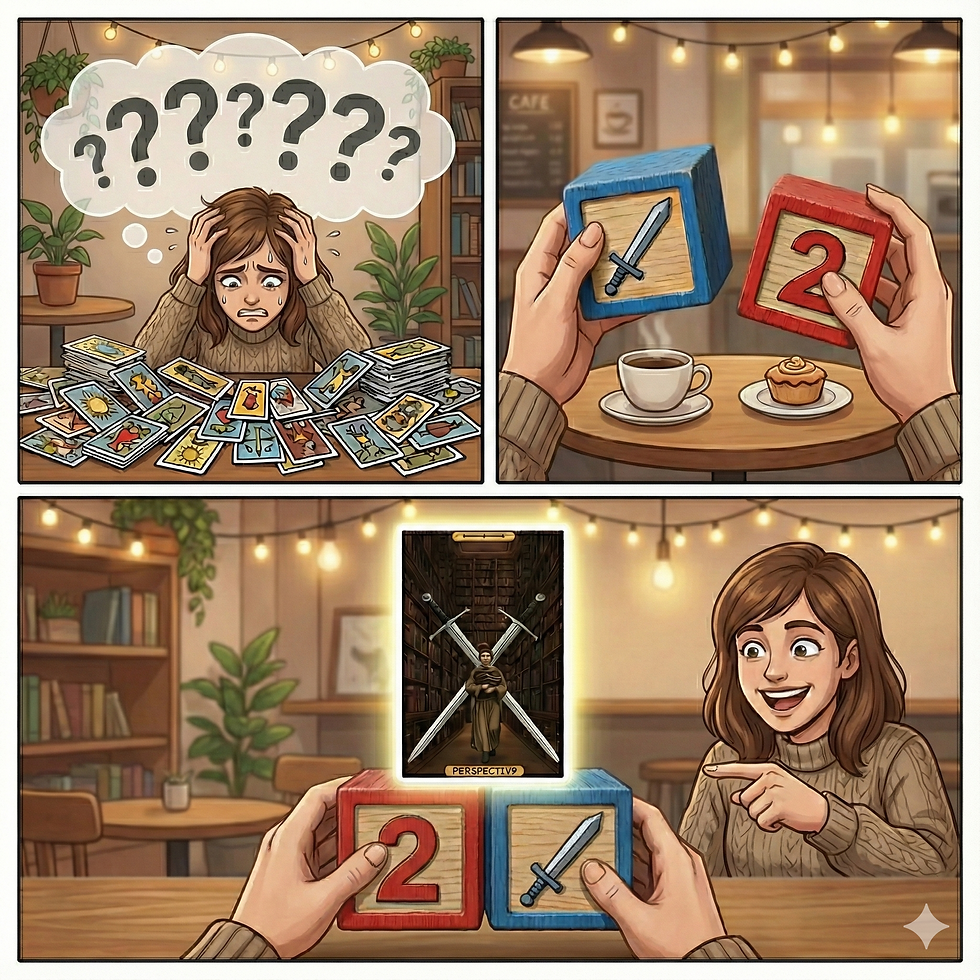
The Building Blocks method moves away from memorizing these static maps. Rather than accepting a single word as the meaning of a card, this approach focuses on the individual symbols; to construct a deeper concept.
By examining base symbols—such as the concept of the Sword as an element, or the Ace as the start of a sequence—and seeing how they combine, the student develops a comprehensive understanding. Ultimately, a single word may still be used as a memory jog, but that word now represents several layers of built-up conceptual knowledge. The true meaning of the card is found within that deeper concept, rather than the word itself.

Interested? Have a look at:
TAROT: A Modular "Building Blocks" Approach (Blog Entry)
Why the "Building Blocks" Approach is the Future of Tarot (Blog Entry)
Tarot’s Secret Skeleton: Do You Really Need the Qabalah? (Blog Entry)
The Building Blocks Course (Web page)
Building Blocks course content (on Payhip)

Comments